
The Jaw–Pelvic Floor Connection
(Part 3 of our 3-Part Special on Oral Health in Midlife Women)
In Part 1, we explored how menopause affects your gums and saliva.
In Part 2, we unpacked the mouth–uterus connection through mucous membranes and embryology.
Now we come to one of the most fascinating — and most overlooked — pieces of the puzzle:
The jaw–pelvic floor connection.
If you clench your jaw…
If you grind your teeth…
If you carry tension in your hips or pelvis…
This article is for you.
The Body Is One Continuous Web
Your body is not built in compartments.
It is wrapped in fascia, a continuous connective tissue network that surrounds and connects muscles, organs, nerves and joints from head to toe.
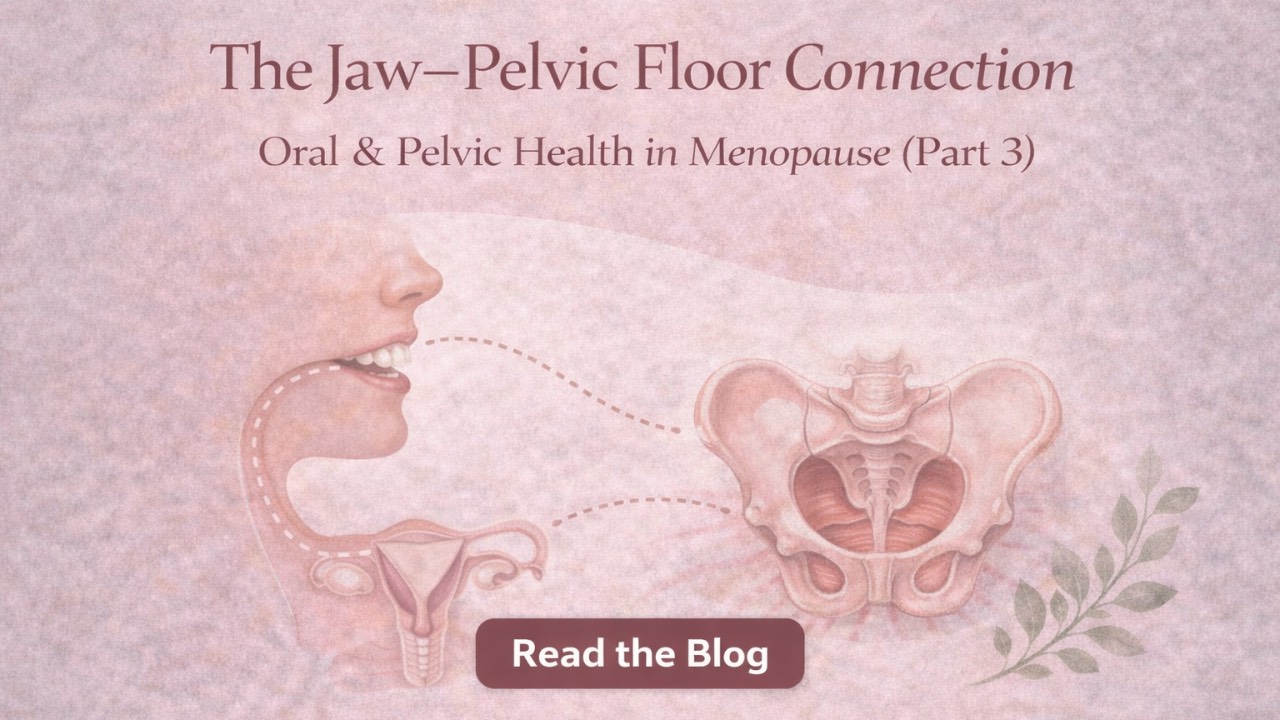
There is even a recognised fascial pathway, often described as part of the deep front line, that runs from the tongue, through the throat and diaphragm, into the pelvic floor, and down the inner legs toward the feet.
This does not mean your tongue is physically “pulling” your big toe.
But it does mean tension patterns can travel through connected fascial planes.
The tongue, diaphragm and pelvic floor operate as one functional pressure and support system.
And that matters — especially in midlife.
Why the Jaw and Pelvis Mirror Each Other
In clinical practice, we often see patterns such as:
-
jaw clenching alongside pelvic floor tightness
-
TMJ symptoms paired with bladder urgency
-
neck tension with uterine heaviness
-
stress showing up in both the mouth and hips
The jaw and pelvic floor are both highly sensitive to stress and nervous system activation.
When the nervous system shifts into protective mode, breathing becomes shallow, the diaphragm stiffens, and pressure dynamics change. Tension travels upward into the jaw and downward into the pelvis.
It is not random.
It is a stress circuit.
Menopause and Fascial Resilience
Estrogen does more than regulate cycles.
It supports collagen quality, tissue hydration and elasticity throughout the body.
As estrogen declines during perimenopause and menopause:
-
connective tissue becomes less elastic
-
fascia becomes less hydrated
-
tissues are more prone to restriction
-
recovery from tension slows
This is one reason many women notice increased jaw tightness, hip stiffness or pelvic tension in midlife.
The system simply has less buffer.
The Tongue–Diaphragm–Pelvic Floor Relationship
The tongue influences jaw alignment, airway space and breathing mechanics.
When the tongue is tense or habitually pressed downward, it alters jaw positioning and neck tone. That affects diaphragm movement, and the diaphragm is mechanically and pressure-linked to the pelvic floor.
When breathing is shallow, the pelvic floor often becomes overactive.
When the pelvic floor is holding, jaw tension often increases.
Simple shifts in breath and tongue posture can soften both areas.
This is not mystical.
It is mechanics and neurology working together.
Why This Matters for Oral Health
Chronic jaw tension can:
-
reduce circulation to gum tissues
-
increase TMJ strain
-
contribute to headaches
-
amplify oral sensitivity
Pelvic floor overactivity can:
-
influence bladder symptoms
-
affect uterine circulation
-
reinforce stress patterns
When we calm one end of the system, the other often responds.
This is where a whole-body approach becomes powerful.
Gentle Ways to Reset the Jaw–Pelvic Circuit
You do not need aggressive intervention.
Start with awareness.
Notice if your teeth are touching when you are not eating.
Allow your tongue to rest gently on the roof of your mouth.
Let your breath expand into your lower ribs.
Introduce simple resets:
Slow diaphragmatic breathing.
Longer, extended exhales.
Gentle jaw softening.
Soft hip mobility.
Walking to encourage circulation.
Humming to stimulate vagal tone.
Small, consistent changes can reduce the tension loop between jaw and pelvis.
The Power of Team Care in Midlife
Understanding this connection also highlights something important:
No single practitioner holds the entire picture.
Integrated care makes a difference.
An experienced biological or airway-aware dentist can assess jaw alignment, clenching patterns and oral inflammation. Addressing bite mechanics and reducing oral tension can improve circulation and reduce stress signalling.
Bowen therapy works gently with the fascial system, helping reset muscle tone and restore balance along long fascial lines, including the jaw–diaphragm–pelvic pathway.
Craniosacral therapy works with cranial and sacral dynamics through the dural membranes and central nervous system. Because the cranium and sacrum are linked, releasing tension at one end often influences the other.
Chiropractic or Osteopathic care takes a whole-body structural approach, assessing how spinal alignment, rib mobility, diaphragm movement and pelvic balance influence organ function and tension patterns.
Pelvic floor physiotherapists play a vital role in assessing and retraining pelvic floor tone, breathing mechanics and pressure management patterns, particularly in women experiencing overactivity, bladder symptoms or pelvic tension during menopause.
Orofacial myologists specialise in tongue posture, jaw function, airway mechanics and oral muscle retraining, helping to reduce clenching patterns and restore balanced breathing and oral tone.
In women navigating menopause, coordinated care can:
-
reduce chronic jaw clenching
-
improve breathing mechanics
-
soften pelvic floor overactivity
-
enhance circulation to oral and pelvic tissues
-
calm the stress response
This is not about fixing isolated symptoms.
It is about supporting the system.
Bringing the Series Together
Across this 3-part series, we have explored how menopause affects:
-
oral tissues
-
mucous membranes
-
connective tissue
-
nervous system tone
Your mouth, uterus and pelvic floor are not separate conversations.
They are different expressions of the same internal transition.
When we support oral health in midlife, we are also supporting pelvic circulation, fascial resilience and nervous system balance.
That is the power of integrated care.
Final Thought
If your jaw feels tight…
If your gums feel sensitive…
If your pelvis feels heavy…
It may not be three separate problems.
It may be one connected system asking for support.
And that is exactly how we approach menopause inside Menopause Natural Solutions.
Explore Consutations with us.
with us.
Author

Jennifer Harrington
Clinical Director
Menopause Specialist, Naturopath, Nutritionist, Medical Herbalist
Stay connected with news and updates!
Recent Posts
