
Musculoskeletal Syndrome of Menopause: Why Does My Body Hurt?
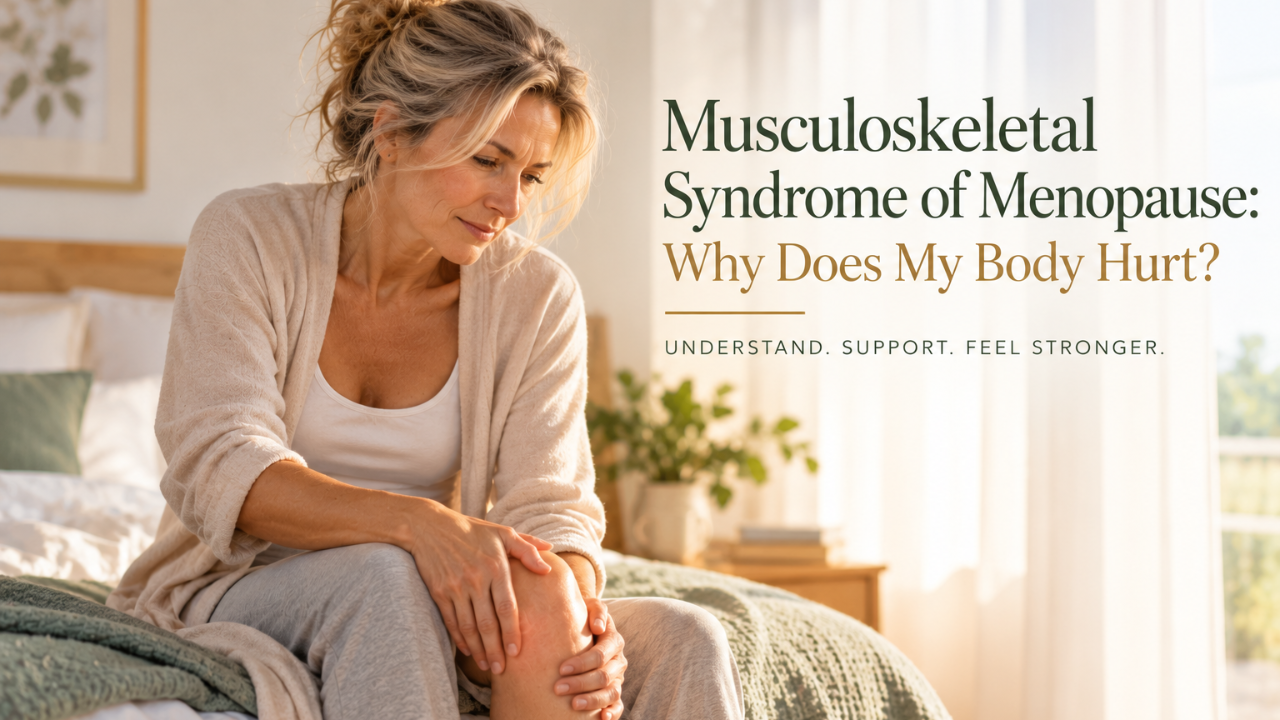
Have you reached your 40s or 50s and suddenly found yourself waking up feeling stiff, achy or sore?
Perhaps your knees complain when you get up from the couch. Your shoulders feel stiff in the morning. Your feet hurt when you first get out of bed. You're not recovering from exercise as quickly as you once did, or old injuries have suddenly started bothering you again.
For years, symptoms such as hot flushes, night sweats and changing periods have dominated the menopause conversation.
But there is another group of symptoms that deserves much more attention: changes to our muscles, joints, tendons and bones.
Researchers have recently proposed a name for this collection of changes: Musculoskeletal Syndrome of Menopause (MSM).
What is Musculoskeletal Syndrome of Menopause?
The term Musculoskeletal Syndrome of Menopause was proposed in a 2024 paper published in Climacteric to describe the collective musculoskeletal changes that can occur as women transition from perimenopause into postmenopause.
These can include:
-
joint pain and stiffness
-
loss of muscle mass and strength
-
loss of bone density
-
changes to tendons and connective tissue
-
increased risk of injury
-
progression of osteoarthritis.
The researchers estimated that more than 70% of women experience musculoskeletal symptoms during the menopause transition, with around 25% experiencing symptoms significant enough to be disabling.
Importantly, MSM is a relatively new term rather than a formal medical diagnosis, but it is helping to draw attention to an aspect of menopause that many women have been experiencing for years.¹
Just how common are muscle and joint symptoms?
New research published in 2026 provides an even clearer picture.
A systematic review and meta-analysis brought together 37 studies from 22 countries involving 93,021 women.
Muscle or joint pain was reported by:
-
40% of premenopausal women
-
57% of perimenopausal women
-
59% of postmenopausal women
Compared with premenopausal women, the risk of muscle or joint pain was 35% higher during perimenopause and 40% higher after menopause.
Back pain followed a similar pattern, increasing from approximately 42% before menopause to 57% during perimenopause and 59% after menopause.
So if you've found yourself wondering, "Why does my body suddenly hurt?", you're certainly not alone.
Why does menopause affect the musculoskeletal system?
Oestrogen does much more than regulate our menstrual cycle.
Oestrogen receptors are found throughout our muscles, bones, cartilage, tendons, ligaments and connective tissues. As oestrogen fluctuates during perimenopause and eventually declines after menopause, this may influence several aspects of musculoskeletal health.
Muscle: Ageing is already associated with gradual loss of muscle mass and strength, and hormonal changes may add another layer. Less muscle can mean less support around our joints, reduced stability and changes in how our bodies respond to physical load.
Tendons, ligaments and connective tissue: Oestrogen is involved in collagen and connective-tissue biology. Changes through menopause may contribute to stiffness, altered recovery and vulnerability to certain injuries.
Joints and cartilage: Oestrogen interacts with cartilage, synovial tissue and inflammatory pathways within our joints. Age, previous injuries, genetics and body composition also matter, but hormonal change may contribute to why joint symptoms become more noticeable.
Bone: Declining oestrogen accelerates bone loss, particularly around the final menstrual period and early postmenopausal years. Protecting our bones therefore needs to begin well before osteoporosis becomes a problem.¹
What can we do about it?
The encouraging part of the MSM conversation is that there are many modifiable factors that support our muscles, bones and joints.
1. Build strength and keep moving
Walking is wonderful, but it isn't the whole answer. Our muscles and bones need appropriate loading.
Resistance training helps preserve and build muscle strength while providing an important stimulus for bone. The key is finding an appropriate starting point and gradually progressing.
But not all movement needs to be structured exercise.
I'm a big fan of Qigong, which combines gentle movement, stretching, balance, breathing and relaxation. Research in postmenopausal women found that 12 weeks of Qigong improved physical functioning and bodily pain, while another study found improvements in muscle strength and postural control.²˒³
Practices such as stretching, shaking, tapping, twisting and gentle bouncing can also be simple ways to keep the body moving throughout the day. Movement encourages circulation and mobility, while muscle contractions and deeper breathing support the normal movement of lymph.
I like to think about movement in two ways:
Build strength and keep moving.
And if you're already experiencing pain, exercise may need to be modified rather than abandoned.
2. Eat enough protein and amino acids
Protein provides the amino acids required to maintain and repair our muscles and other tissues.
I generally encourage good-quality animal protein, including eggs, fish, seafood, poultry, meat and dairy where these suit the individual. As we age, both total protein intake and spreading good-quality protein across the day become increasingly important.
If you're struggling to achieve enough through food alone, a good-quality protein powder can be an easy way to optimise your daily intake.
Leucine is particularly important for stimulating muscle protein synthesis. HMB, a metabolite of leucine, has also been studied for its potential to support muscle mass, strength and physical function as we age.
Collagen-rich foods such as bone broth provide additional amino acids used within connective tissues, although they shouldn't replace complete protein sources for maintaining muscle.
Rather than simply asking, "Am I eating healthily?", ask:
"Am I giving my muscles and connective tissues enough building material?"
3. Build an anti-inflammatory plate
There isn't one special "menopause pain diet", but the way we eat can influence inflammation, metabolic health and tissue repair.
I favour a predominantly Mediterranean-style way of eating with plenty of colourful vegetables and fruit, quality protein, nuts and seeds, herbs and spices, oily fish and healthy fats.
Extra virgin olive oil deserves a special mention. In addition to its monounsaturated fats, EVOO contains polyphenols including oleocanthal, which has interesting anti-inflammatory activity. Human research suggests higher-polyphenol olive oils may improve inflammatory markers, while emerging research is investigating olive-derived polyphenols for joint pain.
If you're specifically looking for a high-polyphenol EVOO, look for independent testing. As a practical guide, 500 mg/kg or above is high in polyphenols, while oils approaching 1,000 mg/kg are particularly polyphenol-rich. Look for a recent harvest date, dark glass or tin and ideally an early-harvest oil. A fresh high-polyphenol EVOO will often have a distinctly bitter, peppery flavour.
Think about what you can add to your plate:
quality protein + colourful plants + healthy fats + herbs and spices.
4. Don't forget the nutrients your musculoskeletal system needs
Several nutrients deserve consideration when we're thinking about muscles, bones, inflammation and pain.
Vitamin D: There is a clear association between low vitamin D and musculoskeletal pain. A meta-analysis of 81 observational studies involving more than 50,000 people found significantly lower vitamin D levels in people with arthritis, muscle pain and chronic widespread pain.
Magnesium is involved in normal muscle contraction and relaxation, nerve function and bone health. Magnesium status is important for healthy neuromuscular function, with additional relevance for some women experiencing symptoms such as muscle cramps or migraine.
Omega-3 fatty acids, particularly EPA and DHA from oily fish and fish oil, are particularly interesting from an inflammatory pain perspective. Research suggests omega-3 supplementation may help reduce chronic pain, particularly in inflammatory pain conditions.
These nutrients aren't simply about treating pain. They're part of providing the raw materials and physiological environment our muscles, bones, nerves and joints need to function well.
5. Support your metabolic health
There is also a growing connection between metabolic health and chronic pain.
A 2025 review of 28 studies found that metabolic syndrome was common in people living with chronic pain and was associated with greater pain and functional limitations in several chronic pain conditions.⁴
This relationship appears to go beyond body weight alone.
Adipose tissue isn't simply somewhere we store fat. It is metabolically and hormonally active tissue, producing adipokines and inflammatory mediators that can influence tissues throughout the body.
Muscle is metabolically active too. Skeletal muscle is one of our major sites for glucose disposal, plays an important role in insulin sensitivity and produces its own signalling molecules, known as myokines.
This becomes particularly relevant during menopause, when changes in body composition, muscle mass, insulin sensitivity and the tendency to accumulate more visceral fat can occur.
So maintaining muscle and supporting a healthy body composition isn't simply about how our body looks. It influences our metabolic and inflammatory environment as well as supporting the muscles, bones and joints that keep us moving.
Another good reason to build strength and keep moving.
Start thinking about your musculoskeletal health now
The emerging research into Musculoskeletal Syndrome of Menopause gives us another reason to broaden the menopause conversation.
It's not only about periods, hot flushes and hormones.
It's also about protecting the muscles that move us, the joints that support us, the tendons that connect us and the bones that carry us into later life.
And we don't need to wait until something hurts before we start supporting them.
Over the coming weeks, I'll be exploring what else may help — including heat therapy, acupuncture, massage and technologies such as PEMF, before looking more closely at natural pain-support options including PEA and curcumin.
If you are experiencing severe, worsening or persistent pain, however, don't automatically assume it's menopause. Pain associated with significant swelling, weakness or changes in function deserves appropriate investigation.
Feeling stiff, achy or sore may be common during the menopause transition.
But common does not mean it's normal.
References
-
Wright VJ, Schwartzman JD, Itinoche R, Wittstein J. The Musculoskeletal Syndrome of Menopause. Climacteric. 2024;27(5):466–472. doi:10.1080/13697137.2024.2380363.
-
Kruse C, McKechnie T, Dworsky-Fried J, et al. Musculoskeletal Manifestations of Perimenopause: A Systematic Review and Meta-Analysis of 93,021 Women. JB JS Open Access. 2026;11(1).00254. doi:10.2106/JBJS.OA.25.00254.
-
Aibar-Almazán A, et al. Impact of Qigong Exercises on the Severity of the Menopausal Symptoms and Health-Related Quality of Life: A Randomised Controlled Trial. 2022.
-
Carcelén-Fraile MDC, et al. Qigong for Muscle Strength and Static Postural Control in Middle-Aged and Older Postmenopausal Women: A Randomized Controlled Trial. Front Med. 2021.
-
Wu Z, Malihi Z, Stewart AW, Lawes CMM, Scragg R. The Association Between Vitamin D Concentration and Pain: A Systematic Review and Meta-Analysis. Public Health Nutr. 2018;21(11):2022–2037. doi:10.1017/S1368980018000551.
-
Xie L, Wang X, Chu J, et al. Effects of Omega-3 Fatty Acids on Chronic Pain: A Systematic Review and Meta-Analysis. Front Med (Lausanne). 2025;12:1654661. doi:10.3389/fmed.2025.1654661.
-
Encalada S, et al. The Association Between Chronic Pain and Metabolic Syndrome: A Scoping Review. PM&R. 2025;17(9):1107–1119.
Author

Jennifer Harrington
Clinical Director
Menopause Specialist, Naturopath, Nutritionist, Medical Herbalist
Stay connected with news and updates!
Recent Posts
