
Menopause Joint and Muscle Pain: Can Natural Supplements Help?
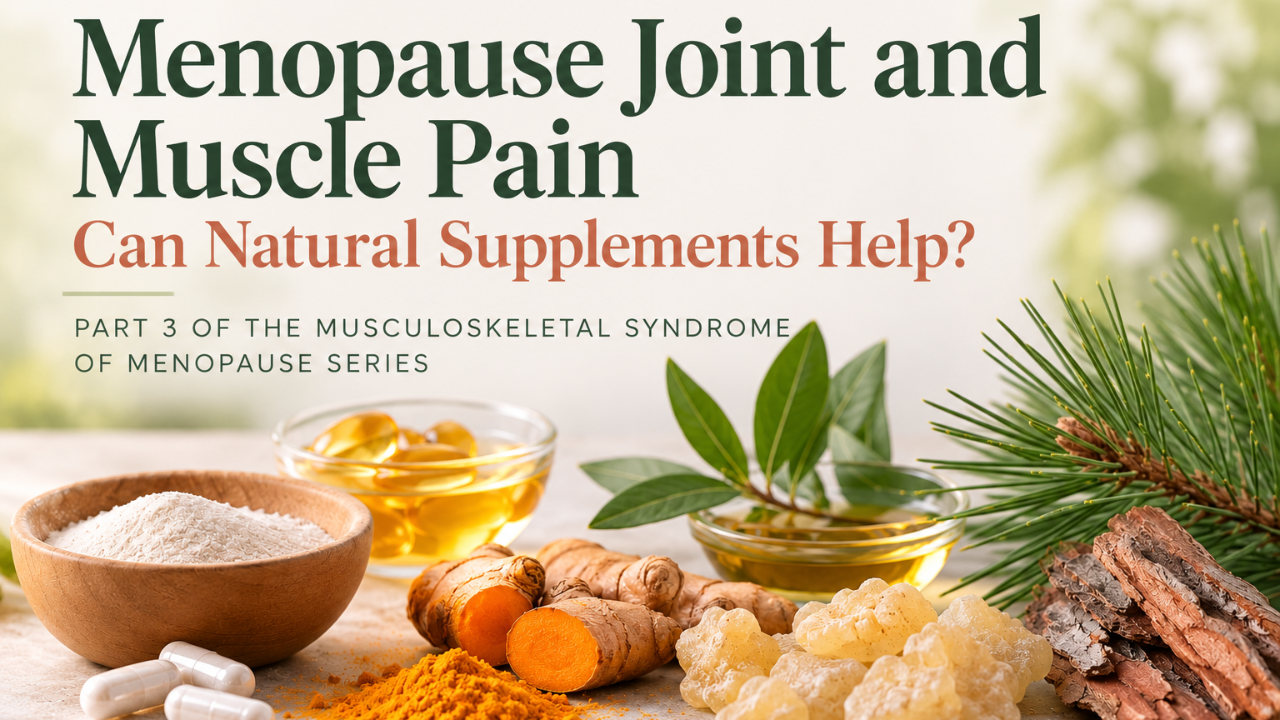
Part 3 of the Musculoskeletal Syndrome of Menopause Series
Joint pain, stiffness and muscle aches can become more noticeable during perimenopause and menopause.
In Part 1 of this series, we explored Musculoskeletal Syndrome of Menopause (MSM) and the foundations of musculoskeletal health, including movement, strength, protein, key nutrients and metabolic health.
In Part 2, we looked beyond exercise at supportive therapies including heat, acupuncture, massage, PEMF, photobiomodulation and whole-body vibration.
Now let's look at five natural compounds that may provide additional support: PEA, specialised pro-resolving mediators (SPMs), Turmeric, Boswellia and Maritime Pine.
They don't all work in the same way. Some influence pain signalling, some inflammatory pathways, while others may help support the body's natural resolution and recovery processes.
1. PEA: Supporting Pain Regulation
One of the natural compounds I find particularly interesting for persistent pain is palmitoylethanolamide, commonly abbreviated to PEA.
PEA is a naturally occurring fatty acid amide produced within the body.
It belongs to a family of compounds involved in cellular communication and the regulation of inflammatory responses.
Although sometimes described as an endocannabinoid-like compound, PEA is not intoxicating and does not act like THC.
How does PEA work?
PEA influences several biological pathways associated with pain.
One of its primary actions involves activating a receptor called PPAR-alpha.
This receptor participates in regulating inflammatory signalling, lipid metabolism and cellular responses to stress.
PEA has also attracted attention because of its effects on two important types of immune cells.
Mast cells
Most people associate mast cells with allergies and histamine.
However, mast cells are also involved in tissue inflammation and pain signalling.
When activated, they release numerous chemical messengers that can influence nearby nerves and tissues.
Experimental research suggests PEA may help regulate excessive mast-cell activity.
Microglia
Microglia are specialised immune cells found within the central nervous system.
They help maintain a healthy neurological environment, but persistent activation can contribute to neuroinflammatory signalling and increased pain sensitivity.
PEA has demonstrated effects on microglial activity in laboratory and animal research.
This makes it particularly interesting when pain involves more than local tissue inflammation.
A 2023 systematic review and meta-analysis of 11 double-blind randomised controlled trials involving 774 people found that PEA reduced chronic pain compared with control treatments. Some studies also reported improvements in physical function and quality of life.
Why I like PEA: Rather than simply acting as another anti-inflammatory, it offers an interesting way of looking at pain through cellular communication, mast cells and nervous system sensitivity.
2. SPMs: Helping Inflammation Resolve
Here's something many women don't realise.
Inflammation isn't supposed to continue indefinitely.
When we experience an injury or tissue irritation, inflammation helps initiate the healing process.
Immune cells respond, damaged material is cleared and tissue repair begins.
But inflammation also needs an appropriate ending.
And this doesn't happen simply because the body stops producing inflammatory chemicals.
We now understand that inflammation resolution is an active biological process.
What are specialised pro-resolving mediators?
Specialised pro-resolving mediators, or SPMs, are naturally occurring lipid-signalling molecules involved in regulating the resolution of inflammation.
They include several families of compounds.
Resolvins help regulate inflammatory responses and immune-cell activity.
Protectins participate in tissue protection and inflammatory regulation.
Maresins support processes involved in clearing cellular debris and restoring tissue balance.
Many of these compounds are derived from omega-3 fatty acids, particularly EPA and DHA.
However, SPM-enriched marine oils are different from conventional fish oil.
Some preparations are enriched with compounds such as 17-HDHA and 18-HEPE, which are biochemical precursors involved in producing certain resolvins.
Why is inflammation resolution important for pain?
Persistent pain can involve ongoing inflammatory signalling, altered immune-cell activity, nerve sensitisation and changes in tissue recovery.
SPMs participate in biological processes that help regulate immune responses and promote the clearance of damaged cells and cellular debris.
Rather than simply blocking inflammatory activity, researchers are investigating whether supporting these resolution pathways could help restore a healthier inflammatory balance.
This is particularly interesting when considering chronic pain.
A small 2020 study of adults with chronic pain found improvements in pain and quality of life following four weeks of an SPM-precursor-enriched marine oil.
A separate randomised, double-blind, placebo-controlled study demonstrated that an enriched marine oil could increase circulating SPMs and influence immune-cell responses.
Why I like SPMs: They shift the conversation from simply trying to suppress inflammation towards supporting the body's ability to resolve it.
3. Turmeric: The Golden Goddess of Menopause
Turmeric has long been one of my favourite menopause herbs. I affectionately refer to it as The Golden Goddess.
Its potential benefits extend well beyond joint pain.
Turmeric (Curcuma longa) contains numerous active plant compounds, including curcuminoids and volatile oils. Research has explored its effects on inflammation, oxidative stress, metabolic health and cardiovascular function, all of which become increasingly relevant at midlife.
For musculoskeletal health, much of the clinical research has focused on curcumin preparations in people with osteoarthritis.
As a herbalist, I also value the wider phytochemical profile of whole turmeric rather than viewing curcumin as its only useful constituent.
You can explore turmeric's broader applications in Turmeric – The Golden Goddess.
Why I like turmeric: It provides potential musculoskeletal support while also fitting into the bigger metabolic and inflammatory picture of menopause.
4. Boswellia: For Joint Pain and Stiffness
Boswellia serrata, or Indian frankincense, has a long history of traditional use for inflammatory conditions.
Its resin contains boswellic acids, including AKBA, which have been investigated for their effects on inflammatory pathways such as 5-lipoxygenase.
Clinical trials have primarily investigated Boswellia for osteoarthritis.
Systematic reviews suggest certain standardised preparations may improve joint pain, stiffness and physical function, although studies have used different extracts and doses.
This makes Boswellia particularly interesting for women whose joint discomfort and stiffness are making it harder to remain active.
Why I like Boswellia: It has a particularly good fit when joint pain and stiffness are limiting movement.
5. Maritime Pine: Joint Health Meets Menopause Support
French Maritime Pine (Pinus pinaster) is another herb that deserves attention because its potential benefits extend beyond joint discomfort.
Much of the research uses the standardised bark extract Pycnogenol, which is rich in polyphenols.
Clinical research has explored its effects on inflammation, oxidative stress, endothelial function and microcirculation, alongside osteoarthritis symptoms including pain, stiffness and physical function.
What makes Maritime Pine particularly interesting for this article is its broader menopause research.
Clinical studies have reported improvements in menopausal complaints including hot flushes, nocturnal sweating, sleep, fatigue and quality of life, as well as joint pain and headaches.
Why I like Maritime Pine: It potentially bridges joint health, inflammation, circulation and the broader menopausal transition.
What About Ginger and Saffron?
Both deserve consideration, but rather than making this article even longer, I've explored them separately.
Ginger has interesting applications for inflammation, joint discomfort and menopause and is also an easy herb to incorporate into the diet. Read more in The Health Benefits of Ginger at Menopause.
Saffron may be particularly relevant when pain occurs alongside disrupted sleep, low mood or increased stress sensitivity. You can read more in Saffron for Menopause.
Which One Is Right for You?
There isn't one best supplement for menopausal joint and muscle pain.
The better question is:
What's contributing to your pain?
PEA may be particularly interesting where pain signalling, mast cells or nerve sensitivity are involved.
SPMs offer a different approach by supporting inflammation resolution.
Turmeric provides broader inflammatory and metabolic support.
Boswellia has particular relevance to joint pain and stiffness.
Maritime Pine provides an interesting crossover between musculoskeletal and broader menopausal support.
And sometimes none of these is the answer.
Pain may be related to osteoarthritis, inflammatory arthritis, tendon injury, thyroid dysfunction, nutritional deficiencies or another condition requiring investigation.
New or persistent swelling, prolonged morning stiffness, progressive weakness or unexplained pain should be appropriately assessed.
The Bigger Picture
Natural supplements can be useful, but they are only one part of supporting musculoskeletal health during menopause.
As we explored earlier in this series, movement, strength training, adequate protein, good nutrition, metabolic health, sleep and recovery remain the foundations.
What I particularly like about the five compounds we've explored here is that they demonstrate just how differently we can approach pain.
PEA — pain regulation and neuroinflammation.
SPMs — inflammation resolution.
Turmeric — inflammatory and metabolic support.
Boswellia — joint pain and stiffness.
Maritime Pine — joint, vascular and broader menopausal support.
The goal isn't necessarily to take all five.
It's to identify what is driving your symptoms and choose support accordingly.
Because while musculoskeletal discomfort becomes increasingly common during the menopausal transition, common does not mean it's normal to suffer through it.
Menopause is a transition, not a diagnosis.
And when it comes to protecting your musculoskeletal health:
Build strength and keep moving.
Coming Next
In the final article in this series, we'll bring everything together into a practical guide to Musculoskeletal Syndrome of Menopause, from movement and nutrition to complementary therapies and targeted natural support.
Research References
-
Wright VJ et al. The musculoskeletal syndrome of menopause. Climacteric. 2024;27(5):466–472. doi:10.1080/13697137.2024.2380363.
-
Lang-Illievich K et al. Palmitoylethanolamide in the Treatment of Chronic Pain: A Systematic Review and Meta-Analysis of Double-Blind Randomized Controlled Trials. Nutrients. 2023;15(6):1350.
-
Callan N, Hanes D, Bradley R. Early evidence of efficacy for orally administered SPM-enriched marine lipid fraction on quality of life and pain in a sample of adults with chronic pain. Journal of Translational Medicine.2020;18:401.
-
Souza PR et al. Enriched Marine Oil Supplements Increase Peripheral Blood Specialized Pro-Resolving Mediators Concentrations and Reprogram Host Immune Responses. Circulation Research. 2020;126(1):75–90.
-
Inprasit C et al. Evaluating the efficacy and safety of Curcuma longa, Boswellia serrata, and their mixed formulation in treating knee osteoarthritis: a systematic review and network meta-analysis. Complementary Therapies in Medicine. 2026.
-
Belcaro G et al. Treatment of osteoarthritis with Pycnogenol: The SVOS study. Phytotherapy Research.2008;22(4):518–523.
-
Kohama T, Negami M. Effect of low-dose French maritime pine bark extract on climacteric syndrome in 170 perimenopausal women. Journal of Reproductive Medicine. 2013;58(1–2):39–46.
-
Yang HM et al. A randomised, double-blind, placebo-controlled trial on the effect of Pycnogenol on the climacteric syndrome in peri-menopausal women. Acta Obstetricia et Gynecologica Scandinavica. 2007;86:978–985.
Author

Jennifer Harrington
Clinical Director
Menopause Specialist, Naturopath, Nutritionist, Medical Herbalist
Stay connected with news and updates!
Recent Posts
